
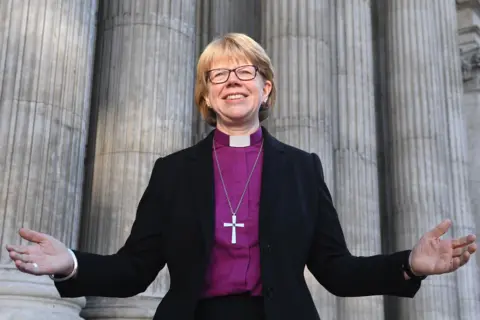
Dame Sarah Mullally has been named as the incoming spiritual leader of the Church of England - creating a milestone as the initial female to be picked for this significant position.
Previously England's chief nursing officer, the sixty-three-year-old entered the priesthood in 2006 and was named as the initial woman to serve as Bishop of London in 2018 - the third most senior member of religious leadership in the Anglican Church.
This marks the initial occasion in almost five centuries of history that the Anglican Communion has nominated a female to assume its leadership.
Historic Selection
The Church has been without someone in the leading position for approximately twelve months after the previous Archbishop stepped down over a protection controversy.
He departed following a critical investigation into a prolific child abuser linked to the religious institution. The report found that he "could and should" have notified authorities about the misconduct by John Smyth of male youths to law enforcement in 2013.
The Archbishop of York took on most of the former Archbishop's responsibilities in an interim move, and was one of the voting members of the committee charged with choosing his successor.
Official Procedure
In line with tradition, the procedure of choosing a spiritual leader involves a candidate being presented to Prime Minister Sir Keir Starmer and then forwarded to the monarch.
The Prime Minister has applauded Dame Sarah's appointment, saying: "This position will serve an important function in our national life. I offer my best wishes and anticipate collaborating."
While, technically, the monarch is head of the Anglican Church, the person occupying the role of spiritual leader is the highest-ranking cleric and is the religious guide of the Church and the worldwide Anglican Communion.
Monarchical and International Reaction
The monarch has praised the new Archbishop on her new role, "which is of such importance in the UK and across the global Anglican Communion", Buckingham Palace stated.
The Global Fellowship of Confessing Anglicans, which advocates for traditional positions, has criticised the appointment, saying that although some will welcome it, "the majority of the Anglican Communion still maintains that the scriptures requires a male-only episcopacy."
Handover Process
She does not legally take on her new role until a formal approval process in the new year, and an installation ceremony comes later, after they have pledged allegiance to the monarch.
In a declaration on the announcement day after her appointment was finalized, she said: "I know this is a significant undertaking but I approach it with a sense of peace and faith in divine guidance to carry me as has consistently occurred."
Speaking from Canterbury Cathedral, she said that "in an age that seeks absolute answers and tribalism, Anglicanism offers something quieter but stronger."
Responding to Attack
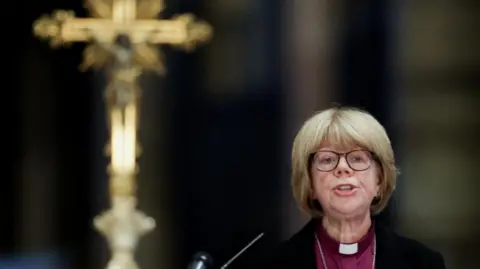
Addressing the "terrible attack" of Thursday's attack on a synagogue in Manchester, she said "we observe hatred that rises up through divisions across our society."
She continued: "We then as a Church have a duty to be a people who stand with the Jewish people against prejudice against Jews in all its forms. Hatred and racism of all types cannot be allowed to divide our society."
Professional History
Married with two children, she devoted more than three decades in the NHS, becoming the youngest-ever chief nursing officer for the country in 1999.
Although she was volunteering in the religious community at the time, it was just a short time after that she decided to become a clergy member and was promptly assigned helping implement changes in the way the institution addressed misconduct.
In that year she became financial administrator at the historic church before assuming the role of diocesan leader in the regional church administration in 2015.
As Bishop of London she was seen as someone who used her experience as an NHS administrator to help modernise the church district.
Guiding Principles
"People frequently inquire what it has been like to have had two careers, first in the NHS and currently in the religious institution.
"I prefer to think that I have always had a single calling: to follow Jesus Christ, to know him and to make him known, continually striving to live with compassion in the assistance to people, whether as a healthcare professional, a priest, or a church official."
Future Challenges
Possibly the pressing issue in her in-tray is still to develop improved approaches towards dealing with misconduct and treating with more compassion those affected by it.
There has also been a reduction in religious participation, though the capital has to a degree bucked that trend.
A particular subject she has been most outspoken about is assisted dying - she is a vociferous opponent, as was her preceding Archbishop.
When legislation was passed in the House of Commons, she described it as "impractical and dangerous and creates danger to the most vulnerable people in our community."
Modern Positions
Among her responsibilities as Bishop of London was to lead a body trying to guide the Church's decision on whether to sanction gay unions.
She described the determination to finally allow clergy to bless same-sex couples in last year as "a moment of hope for the religious community."
Rowan Williams, summarised her position as necessitating a "newspaper in one hand and a Bible in the other."
Dr Williams told journalists "the pressure of having an position on all matters is significantly demanding."

